

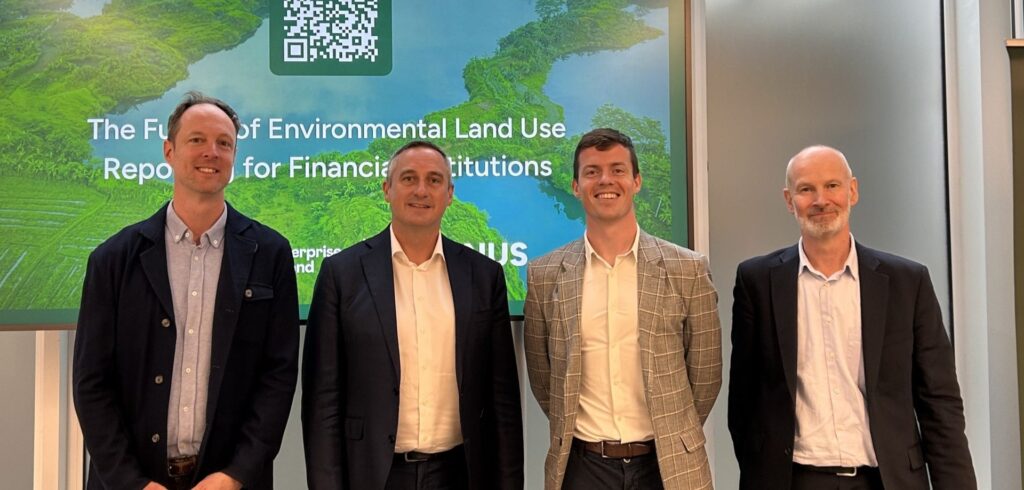
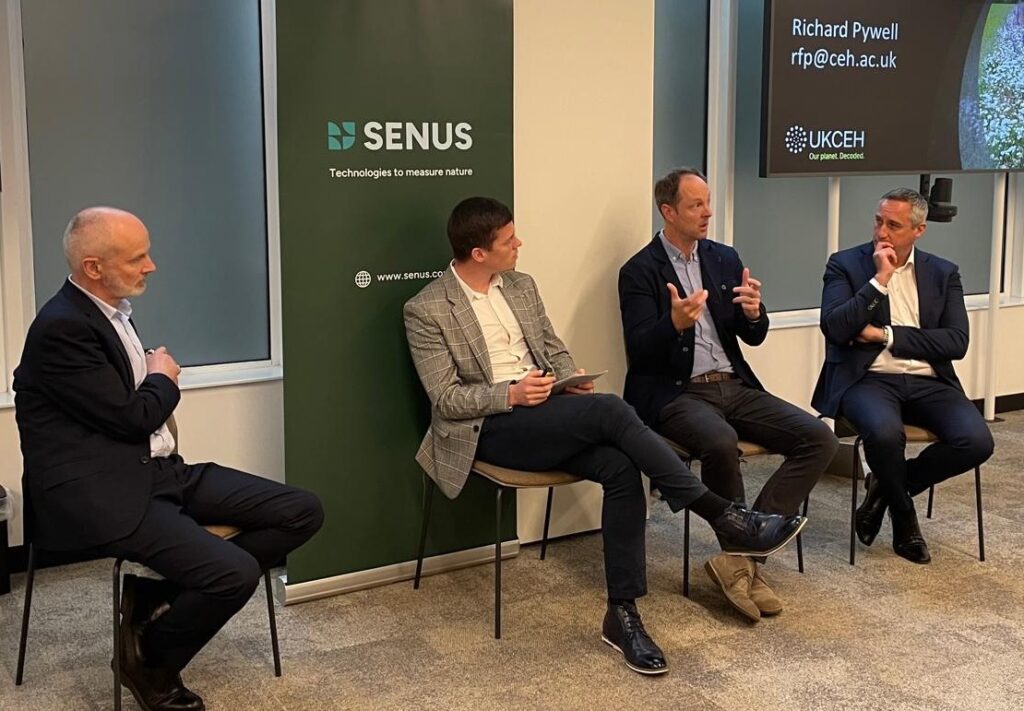
Earlier this month in London, Senus, Bank of Ireland (BOI), and Enterprise Ireland hosted a joint event to discuss the future of environmental land-use reporting for financial institutions. The discussion focused on how advances in land-use intelligence, climate modelling, and agricultural monitoring are transforming risk assessment, lending decisions, and portfolio management. The following insights capture the key themes and takeaways from the event.
1. Land-Use Change is Underestimated and Environmental Data is Disjointed:
The scale and impact of global land-use change have been consistently underestimated, partly due to incompatible land-cover classification systems and siloed datasets across private and public sectors. As a result, meaningful comparisons across geographies remain difficult, limiting the ability of financial institutions to assess environmental risk at scale.
Advances in high-resolution satellite and remote sensing imagery (now available at 12-30 cm resolution) provide the raw material needed to address this challenge. However, the real value lies in what you do with it. Senus applies computer vision, machine learning and AI to translate imagery into actionable intelligence, enabling faster reporting, continuous monitoring, automated alerts, and improved Measurement, Reporting and Verification (MRV) processes.
Complementing these capabilities, the UK Centre for Ecology & Hydrology (UKCEH) maintains extensive long-term environmental monitoring datasets across the UK, combining remote sensing, geospatial modelling and in-field data to provide a more comprehensive understanding of environmental change.
2. Data Silos Remain a Significant Barrier:
Despite significant technological advances, data fragmentation continues to undermine data utility. National datasets operate at different scales, private datasets vary in accessibility, and multiple reporting standards persist across the industry. Data quality and resolution also vary considerably, reducing confidence and limiting interoperability.
As advised by Dr Hugh Sturrock of Senus, best practice would include parcel-level insights, near-real-time updates, a single source of truth, ground-truthed data, and built-in audit trails to ensure accountability.
Professor Richard Pywell of UKCEH highlighted four key steps for action:
- Continuous monitoring and verification
- Repeatable audits of natural capital
- Managing risks at farm-business scale
- Identifying opportunities for environmental adaptation
3. Agriculture is a Disproportionate Emissions Risk for Agricultural Lenders:
Both Bank of Ireland and Lloyds Bank highlighted a striking imbalance in their portfolios. While agriculture represents only approximately 4% of their respective loan books, it accounts for around 15% and 37% of financed emissions, respectively.
For Bank of Ireland, agriculture is the single largest contributor to Scope 3 emissions. As a result, this exposure is driving banks to look at environmental data beyond reporting obligations. Investor and customer pressure is compounding this, and banks are increasingly being held accountable for the environmental impact of their portfolios.
4. Climate Risk is Increasingly Becoming Credit Risk:
UKCEH presented compelling evidence that past farm performance is no longer a reliable indicator of future viability. Advances in climate modelling can now project yield impacts for specific crops (for example, grass, oilseed rape, wheat, and milk) at individual farm level.
In a UKCEH case study of a mixed dairy and arable farm, grass production was shown to decline over time, directly reducing milk yield and, by extension, we can assume the farm’s ability to service debt. For lenders, environmental and climate data are therefore becoming financially material. Tools such as UKCEH’s crop suitability modelling capabilities (covering 160 crop types) enable both farmers and banks to identify emerging risks and opportunities before they translate into financial stress or loan defaults.
5. Engaging Farmers Requires a Financial Hook:
A consistent theme across the panel was that farmers will not act on environmental data unless there is a clear financial benefit (ROI or saving). Information overload, the removal of certain payment schemes, and scepticism around data sharing all create friction between banks, farms, and data providers. The most effective approach is to communicate in economic terms and establish a common language by framing environmental performance in a way that farmers already understand (for example, a BER-style rating for water quality).
There should also be a stronger focus on profitability and resilience rather than compliance. Bank of Ireland is embedding Senus data directly into the loan origination journey, meaning environmental performance will inform lending decisions at the point of application.
6. Banks are Uniquely Positioned to Drive System Change – But Should They Fund it Alone?
Banks occupy a unique position within the agricultural supply chain. Their relationships extend beyond farmers to include processors, distributors, and retailers, giving them multiple touchpoints and significant leverage to accelerate transition.
Bank of Ireland, for example, banks both dairy farmers and the processors they supply, helping to reduce the risk of stranded assets across the value chain. The panel agreed that the most effective banks will be those that move beyond bilateral relationships to become genuine enablers of system-wide change, pulling multiple levers simultaneously across their portfolios.
However, whether banks should be expected to fund the transition continues to be a point of debate, and the return on investment for this new evolution of data-driven environmental services has yet to be fully quantified.ture projects – rather, it is shaping how they are developed, financed, and delivered.
7. Industry Collaboration Over Siloed Solutions:
A recurring message from multiple participants was the need for industry-wide collaboration rather than institution-specific solutions. Initiatives like the Senus–Bank of Ireland pilot, which scaled from five to five hundred farms between 2024 and 2026, demonstrate the value of a shared approach to environmental reporting. Bank of Ireland made it clear that it would like to see the methodology being developed with Senus adopted more widely across the industry, rather than each lender building its own solution independently.
Standardisation, whether in data collection methodologies, MRV frameworks, or farmer-facing tools, can reduce duplication, improve data quality, and help shift farmer perceptions that data sharing is a barrier rather than a benefit.
As Richard Pywell noted, combining multiple data sources and continuously feeding field observations back into models is essential to improving both accuracy and trustworthiness over time. Collaboration across institutions, data providers and farmers will therefore be critical to building the robust environmental intelligence infrastructure needed to support the agricultural transition.
Conclusion
The event highlighted that there is a clear shift underway in how environmental data is being used by financial institutions, moving from a compliance-driven exercise to risk management and decision-making. As climate and land-use pressures grow, access to consistent, actionable data is becoming increasingly critical.
Delivering this will require greater collaboration and standardisation across banks, data providers, scientists, and farmers, alongside continued progress in data integration. Institutions that can effectively translate environmental intelligence into financial insight will be best placed to manage risk, support the transition, and unlock long-term value across the agricultural system.
