

Thomas Malthus, an English Economist, wrote at the turn of the 18th century:
“The land in Ireland is infinitely more peopled than England’s that, in order to give full effect to the natural resources of the country, a great part of the population should be swept from the soil.”
Less than 50 years later, that cold logic would echo through one of the greatest human tragedies in Irish history. It raises a difficult but necessary question for today: what happens when our food systems prioritise extracting resources for the empire over empathy for the people?
The Fairy Bush at Onagh
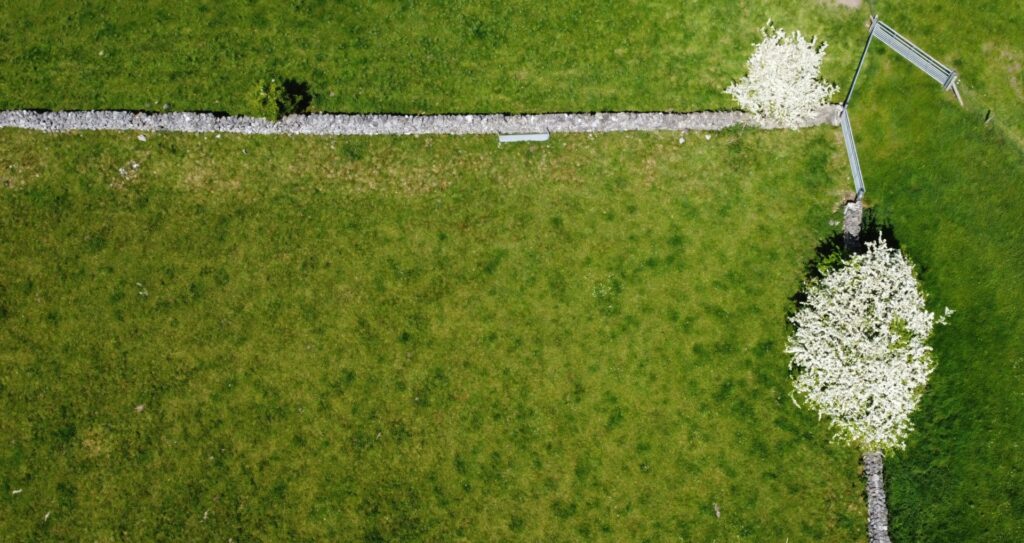
Around 170 years ago, in a small farming village in South Roscommon, the final embers in the last hearth went cold and silence followed. There were twenty-two deserted houses. Before the Great Irish Famine, they had been home to nearly 200 people.
I’ve lived here most of my life, yet our family knows almost nothing about those who once lived here. We don’t know when or why the last families left, where they went, or how many survived. As a child, all that remained of this Onagh village were scattered holes in the ground, “the closhes” as we called them. Nature’s playground for us.
These families lived on about two-acre plots. If they were lucky, they had a cow, a sow and an acre under the plough. Their homes were dug down about four feet into the ground for shelter, with limestone walls framing a small dwelling. Simple, low structures — roofed with scraws. Rudimentary by any standard. Yet these homes sustained families for generations.
And then disaster struck for the tenant farming system. In the mid-1840s, the potato blight destroyed their staple food crop. While famine spread, a British administration continued to export the grain and butter these families produced, prioritising revenue over relief. Malthus had deemed these people “an excess”. Within a decade, a farming village once bustling with life was entirely abandoned. No written accounts of the families, no headstones, no memoirs. A local microcosm of a national tragedy.
The Fairy Bush
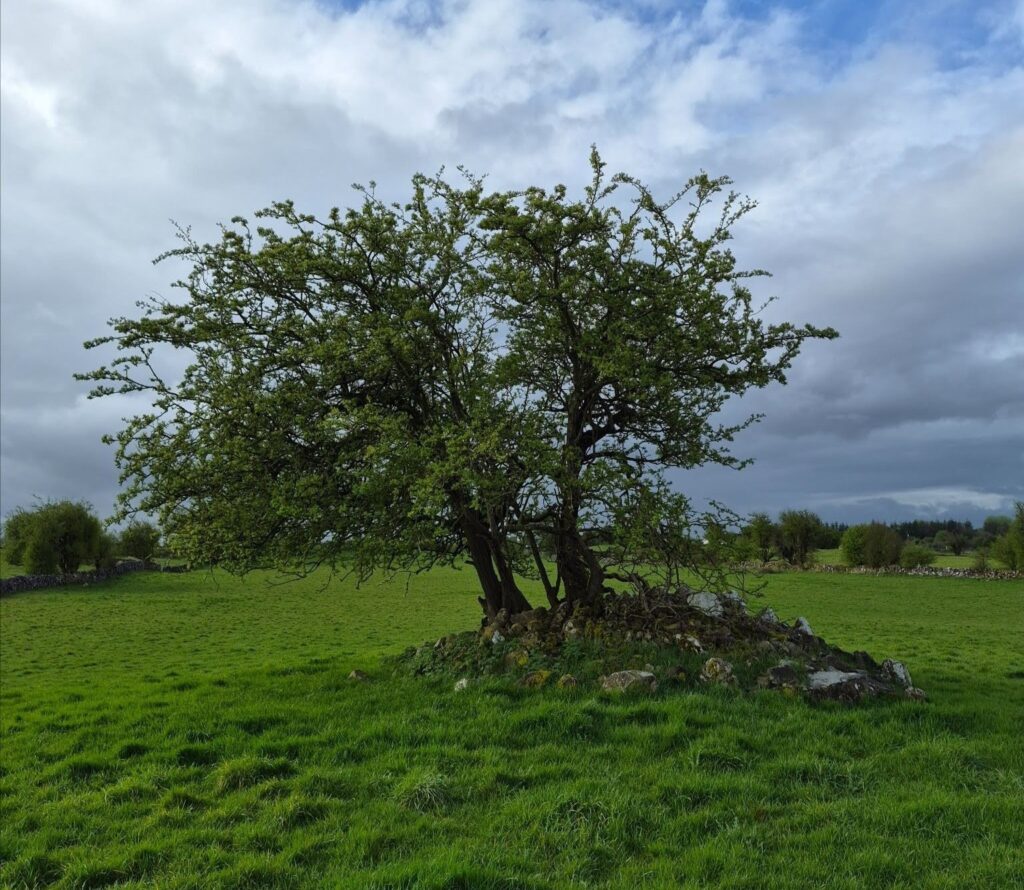
Besides the closhes, the only physical tragic reminder that remained in Onagh in my youth was the Fairy Bush. It appears on no map. No archaeological record. No census. It was likely a burial site, with people laid to rest under a cairn of rough fieldstones. My grandfather, and likely his father before him, called this “The Fairy Bush”. Not because it was haunted, but because it was understood to be sacred. A place not to be disturbed. Who was the last to be buried there? Who laid the stones? We’ll never know. All we knew was to respect it.
A System That Extracted, Not Sustained
My great-grandparents acquired the home farm through the Land Commission around 1910, at least 50 years after that last hearth went cold. In the years between, the land was owned by an absentee landlord named Thomas Newcomen — part of a system that collected rent but contributed nothing to the lives of those who worked the land. A system of resource extraction with little regard for people or place. The populations of western counties like Roscommon suffered some of the greatest losses during An Gorta Mór. Over half in many areas. Perhaps 90% in villages like Onagh. Millions disappeared, some buried in unmarked ground and others emigrating across the world.
Have We Learned Enough?
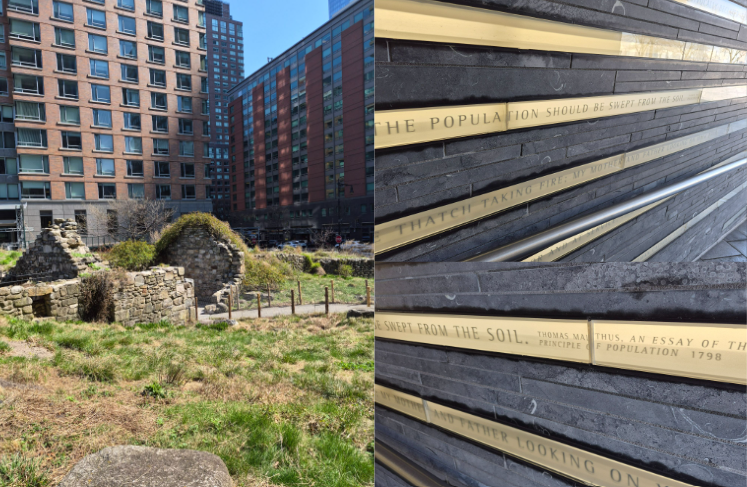
The ancestors of those American immigrants had the wisdom to establish the Irish Hunger Memorial in New York in 2002. It serves as a poignant reminder of the loss of these famine village people and their ancestors. Earlier this month, at the Irish Hunger Memorial in New York, I first read Malthus’ words: “swept from the soil”. As I drove thousands of miles across the US Midwest, the fates of the Onagh people came to mind, as did an uncomfortable question: could we repeat similar mistakes — not in the same form, but through the same mindset?
Today, geopolitical tensions, resource competition, and policy decisions increasingly prioritise markets, efficiency, and short-term outcomes over the long-term resilience of food systems. History offers repeated warnings — from the Romans to the Mayans and the Easter Islanders — that societies which disregarded their natural resources and food systems eventually destabilised, as Jared Diamond has documented. The question is not whether collapse can happen, but whether we recognise the conditions early enough.
Recognising Reality
Driving the endless interstates and midwestern routes last month, I remembered something that I had somehow forgotten: modern economies remain fundamentally dependent on fossil fuels. The United States is, and will remain, a car-based economy. The same applies across much of South America and Asia. Yet “decarbonisation” is often presented as if this dependency has already been solved. It hasn’t.
- Over 70% of Europe’s energy still comes from fossil fuels
- Globally, it is over 80%
- Almost all synthetic fertiliser production depends on fossil fuels
If we fail to acknowledge this reality, we risk building policy on assumptions rather than facts. And systems built on false assumptions do not hold.
The national fuel protests in Ireland this month were sparked by the frustrations of working people from a 50% increase in fuel costs. What societal upheaval would an 80% or 100% increase bring? A government not listening to the pleas of its working people is a government evoking the Malthusian approach.
The Treaty of Rome and the decades that followed ensured food security for the people of Europe through the Common Agricultural Policy, with Governments shaped by the memory of hunger during the Second World War. The 2010s and 2020s have seen policy shifts that, in some cases, have reduced the continent’s resilience in food production. Ultimately, most in Europe will not go hungry, but the knock-on impact of global food price inflation on developing countries could be severe. Food and energy security are becoming priorities in ways most people in Western countries have not experienced in living memory.
Carbon Tax and the Economic Reality
Our green and sustainable food production systems in Ireland are renowned. It’s true that red meat and dairy from Ireland are among the most environmentally efficient on the planet. Yet around 4 million tonnes of imported feed and 1.5 million tonnes of imported fertilisers are required annually to maintain this production. The fate of these inputs is now increasingly vulnerable in a world of energy inflation and global supply chain disruption.
This is where the gap between policy ambition and on-farm reality becomes most visible. If environmental objectives are not aligned with the economic conditions of food production, then the system becomes unstable at the level that matters most — the farm gate. We often succumb to the mistaken impression that in the Western world we have made significant progress in decarbonising our food, energy, and transport systems. Yet we remain overwhelmingly reliant on fossil fuels for almost every aspect of modern life.
The Reality Behind the System
On national radio last week I listened to a report on the impact of the Strait of Hormuz closure on the fertiliser market. The words “gas” and “oil” were never mentioned once in a discussion about “shortages of carbon-intensive fertiliser ingredients”. If we can’t accurately describe our dependencies, it becomes harder to meaningfully address them. The clothes we wear, the beds we sleep in, every product we touch, and even the food we eat, are all produced with or wrapped in petrochemical products. Without oil, gas, coal, and plastics, our country would struggle to function for more than two days a week under current structures.
That’s not a sustainable system. Nor is it realistic to assume that carbon taxes alone will deliver Net Zero without either significant reductions in living standards or major population reductions. Given that neither outcome is politically desirable, a shift in emphasis toward climate impact mitigation — rather than purely decarbonisation narratives — may prove more pragmatic. Countries most closely committed to idealistic Net Zero pathways also face major competitiveness challenges relative to more energy-secure economies.
Much like the decline of the Irish subsistence farming system, structural change may ultimately emerge through economic and political turmoil rather than carefully managed transition. The lesson from history is clear: when systems become misaligned with reality, the costs are ultimately borne by people — as seen in the erasure of places like Onagh. The challenge is whether we can apply those lessons now, rather than after the fact.
At this point, the role of Senus becomes relevant in a different way — not as a policy actor, but as part of the effort to better measure and understand real sustainability in farming systems. Because real sustainability includes economic and social sustainability for the farmer. Without accurate, farm-level data on how food is produced, environmental ambition risks drifting further from operational reality.
Food and Energy Security
In an increasingly volatile world, a nation’s resilience may ultimately be measured by how it prioritises food and energy security. These are the most basic of human needs, and the role of those who produce and manage them must not be underestimated. We all want secure, affordable, and sustainably produced food and energy. But if the cost of transition is disproportionately carried by workers and primary producers, then we risk repeating the mistakes and systemic failures of the 1840s.
Eoghan Finneran
Director of Growth at Senus
