

Many companies have made bold commitments to land-based carbon removals — investing in regenerative agriculture, soil carbon, and nature-based solutions. Until now, there has been no consistent, credible standard for how to account for those removals in a corporate GHG inventory. That changes with the GHG Protocol’s new Land Sector and Removals Standard (LSRS).
Published on 30 January 2026 and effective from 1 January 2027, the LSRS is a supplement to the GHG Protocol’s Corporate Standard and Scope 3 Standard. Version 1.0 covers agriculture and CO₂ removal technologies, and the standard contains a total of 32 requirements that companies must comply with when those requirements are applicable to their business goals and inventory boundary. It currently does not include forestry accounting. It is designed to provide a corporate accounting framework for both land sector emissions and carbon removals in a single, auditable standard.
What the Standard Requires
The LSRS applies to companies with significant land sector activities in their operations or value chain — food and beverage producers, consumer goods companies, retailers, bioenergy businesses, and any company sourcing agricultural commodities. If your supply chain touches farmland, this standard almost certainly applies to you.
While reporting emissions from land use change is mandatory for these companies, reporting CO₂ removals is optional. But for companies that want to — and many do, given the role removals play in net-zero strategies — the requirements are exacting.
To report land management CO₂ removals, companies must:
- demonstrate traceability throughout the full removals pathway;
- use empirical data specific to the carbon pools where carbon is stored;
- provide quantitative uncertainty estimates including confidence intervals;
- prove that reported removals do not overestimate actual carbon stock changes; and
- maintain ongoing monitoring plans to account for any future losses of stored carbon.
Critically, the standard requires that estimates of carbon stock changes be statistically significant, that companies select conservative values from confidence intervals, and that all sources of uncertainty — from natural variability to sampling error to model calibration — be documented and justified. This is a high bar. It is also, for the many companies that have been making removals claims without this level of rigour, a necessary one.
The Three Key Challenges
In practice, companies implementing LSRS removals reporting are likely to face three interconnected challenges.
- The data collection problem. The standard requires data specific to the actual carbon pools where removal is occurring — through direct measurement, calibrated modelling, or hybrid approaches. For companies sourcing from thousands of farms across multiple geographies, knowing where to measure, how often, and at what sample size to achieve representative estimates is genuinely complex. Poorly designed data collection programmes are expensive and may still fail to meet the standard’s requirements.
- The traceability problem. Full physical traceability to land management unit (LMU) level is the gold standard under the LSRS, but it is rarely achievable across an entire supply chain. The standard allows removals to be reported at sourcing region level — but only if specific safeguards are met, including that sampling captures variation due to both natural factors (climate, soil type, topography) and management factors (tillage practices, cropping systems). Companies need models that can generate the most granular estimates possible from the traceability data they do have.
The uncertainty problem. The requirement to provide quantitative uncertainty estimates, with confidence intervals, while selecting conservative values and justifying that removals are not overstated, requires genuine statistical expertise. This is not a standard GHG accounting capability — it draws on methods from ecological sampling, geospatial modelling, and uncertainty propagation that most sustainability teams will not have in-house.
Where Senus Comes In
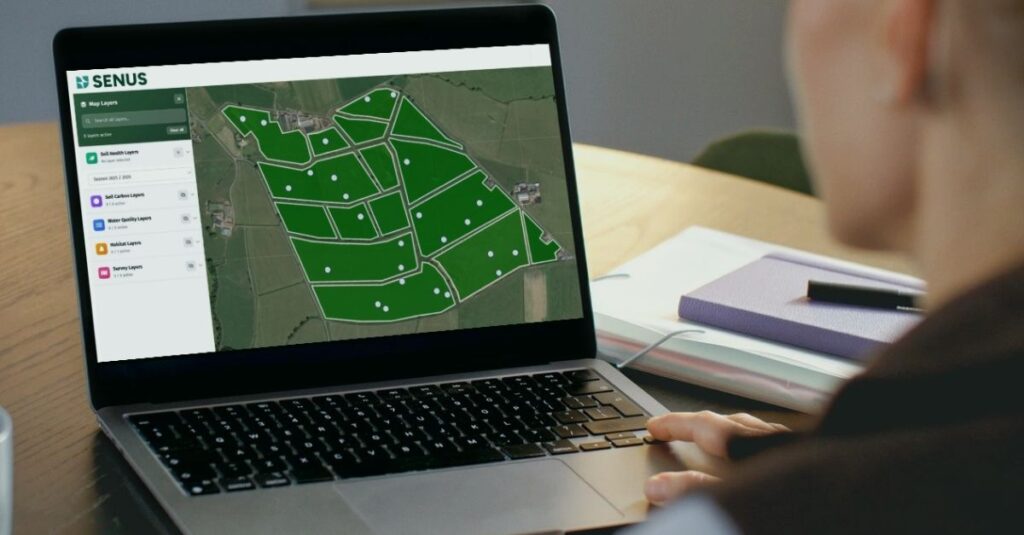
Senus has been built precisely for these kinds of challenges, and our approach maps directly onto each of them.
- Data Collection: Where companies are collecting direct measurement data from land management units, Senus’s models inform the data collection process itself — using existing spatial and agronomic data to identify optimal sampling strategies that maximise statistical representativeness while minimising cost. The result is data collection programmes that are both more efficient and more likely to meet the LSRS’s rigorous sampling requirements.
- Traceability: Where physical traceability to farm level is not achievable, Senus’s modelling can generate the most granular estimates possible from the data that is available — pushing toward sourcing-region or near-LMU resolution using spatial models calibrated against empirical observations, rather than defaulting to coarse regional averages that sacrifice accuracy and credibility.
- Uncertainty: Senus provides the statistical expertise the standard demands. Producing removal estimates that are statistically significant, supported by defensible confidence intervals, and demonstrably conservative requires more than standard GHG accounting software. It requires the kind of rigorous uncertainty quantification that Senus has built into its core methodology — and that will increasingly separate credible removals claims from those that cannot withstand scrutiny.
By addressing these three challenges, Senus helps companies produce credible, auditable removals reports under the new LSRS.
The Window Is Narrow: Practical Implications
The LSRS takes effect in January 2027. Companies aiming to report removals under the new standard should begin preparing data systems, sampling designs, modelling frameworks, and uncertainty protocols well in advance before the first reporting year begins. That work starts now.
If the LSRS affects your business and you want to understand what credible removals reporting looks like in practice, get in touch with the Senus team today.
The GHG Protocol published the Land Sector and Removals Standard (Version 1.0) on 30 January 2026 and will make it effective from 1 January 2027.
Dr. Hugh Sturrock PhD
Head of Research at Senus
